Protection & Fault Handling
I split protection into 'who can see the problem?' and 'who can actually kill the hardware?' The CM5 can watch, log, derate, swap antennas, and try recovery. But if something needs to shut down now, I do not want Linux to be the only thing standing between the PA and a bad state.
Protection Hierarchy
| Layer | Purpose | Examples |
|---|---|---|
| Passive design | Prevent predictable overstress before control logic is involved | Filtering, decoupling, RF matching, thermal copper, current-limited rails |
| Hardware protection | Force an unsafe load off quickly and independently | Comparator trip, eFuse shutdown, hardware enable gating |
| Supervisory software | Interpret context and choose recovery behavior | Reduce TX power, swap antennas, retry a link, log fault history |
| Ground/operator response | Recover or inhibit the subsystem when appropriate | Clear latched state, disable a band, change operating profile |
Fault Matrix
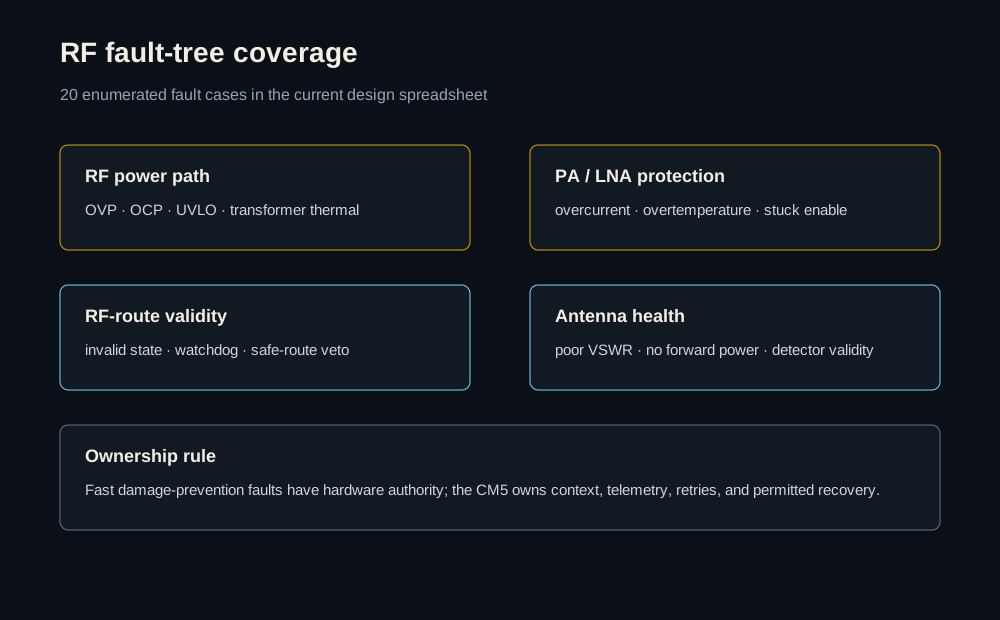
The trip points and latch behavior are still placeholders until I have real thermal/current data from the board.
| Fault | Detection path | Immediate response | Supervisory response |
|---|---|---|---|
| PA overtemperature | Local temperature sensor + comparator | Disable affected PA | Log event; inhibit or derate band until recovery criteria are met |
| PA overcurrent / short | Current sense, comparator, or eFuse | Remove or latch off affected PA/RF rail | Log current/rail state; require defined recovery path |
| Severe antenna mismatch | Forward/reflected RF telemetry | Software may disable PA before changing antenna path | Swap antenna, re-evaluate match, only re-enable TX after safe switch sequencing |
| LNA overtemperature | Temperature monitor | Disable affected receive gain if hardware path is implemented | Log and fall back to alternate mode/path |
| Radio/RF-domain overtemperature | Local temperature monitor | Disable affected RF power domain if threshold is exceeded | Preserve fault record and prevent repeated thermal cycling |
| Rail overvoltage / overcurrent | Power monitor + hardware trip | Disable affected RF branch | Log pre-fault telemetry and isolate the failing branch |
| Invalid RF switch state | Hardware gating / state checks | Keep PA disabled | Re-establish a known safe switch state before retrying |
| CM5 software failure | Watchdog / external supervisor if implemented | Keep default RF enables in a safe state | Reboot/recover without allowing uncontrolled PA enable |
Hardware Versus Software
Same idea for RF switching: software can coordinate the sequence, but I want the hardware defaults/interlocks to make the obviously bad combinations hard to command by accident.
Fault Logging
One fault bit is not enough. I want enough context in the log that I can reconstruct what the radio was doing when it tripped.
- Timestamp or mission-time counter
- Active band and TX/RX mode
- Commanded LR2021 power setting
- Selected T/R and antenna switch state
- Forward and reflected RF measurements
- PA/LNA current and rail voltage
- Relevant temperatures
- Hardware trip/latch inputs
- Recovery action attempted
- Whether the condition repeated after recovery
Recovery Policy
I definitely do not want every fault to auto-clear. A temporary antenna mismatch may justify an antenna swap and retry, while an electrical short or repeated overtemperature event may justify a latched shutdown for the remainder of the mission.
The final firmware should explicitly classify faults into at least three groups: transient/retryable, degraded-mode, and latched/unsafe-to-retry. That classification should be reviewed against the actual hardware protection implementation before flight.
Open Protection Items
- Final trip thresholds and hysteresis for each temperature/current monitor
- Which faults latch in hardware versus software
- Power-cycle behavior after a latched RF eFuse event
- Default states of all PA, LNA, and RF-switch control pins during reset
- Watchdog ownership and CM5 recovery behavior
- Whether loss of health telemetry itself should inhibit high-power TX